20 SEPTEMBER 2026·7 MIN READ
The History of Modern Breathwork: From Ancient Roots to Today
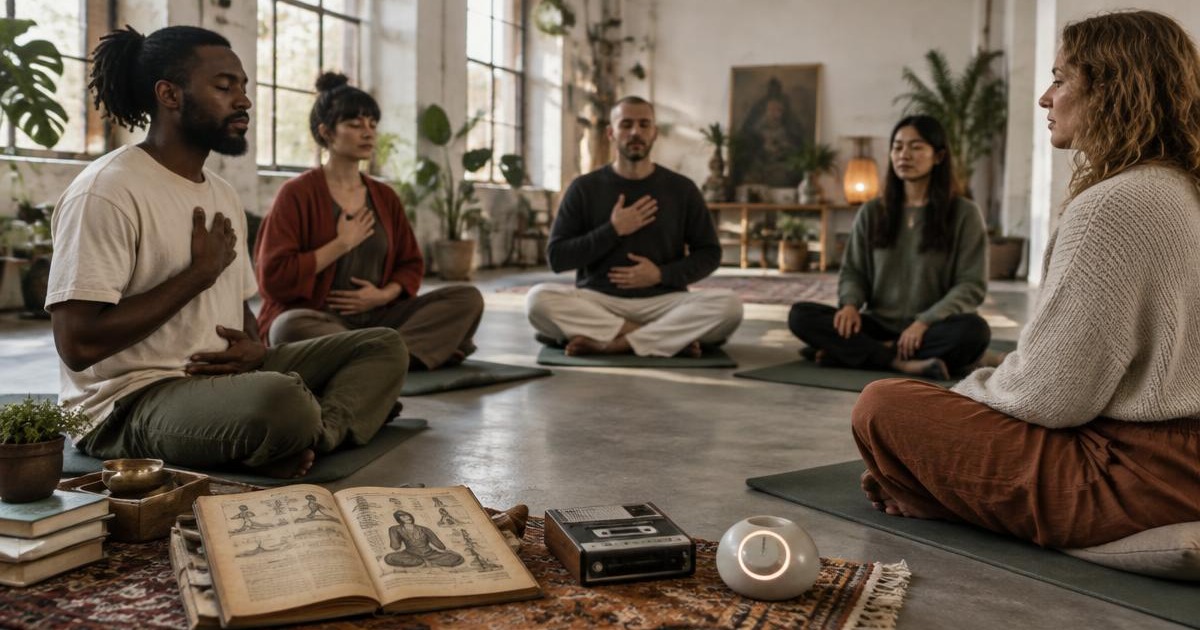
Modern breathwork has no single starting date and no single inventor. It is better understood as a family tree: ancient systems refined the deliberate use of breath over centuries; twentieth-century body psychotherapy connected breathing with emotion and muscular tension; the human-potential movement turned those ideas into experiential group practices; and recent science has helped explain some of the physiology.
That distinction matters. Pranayama, Buddhist breath meditation and Chinese breath-cultivation practices are complete traditions rooted in their own philosophies. Modern schools borrowed, adapted and sometimes radically reinterpreted elements of them. Calling every old breathing practice ‘breathwork’ can erase those differences. This history is therefore a history of influences and reinventions, not one unbroken lineage.
Long Before ‘Breathwork’: Ancient Breath Traditions
The deliberate training of breath is thousands of years old. Indian yogic traditions developed pranayama — practices for regulating the breath and, in their own framework, prana or vital energy. Techniques ranged from alternate-nostril breathing and humming to breath retention and forceful cleansing breaths. Written descriptions appear in classical yoga texts and were expanded considerably in later Hatha Yoga traditions.
Buddhist traditions used awareness of breathing as a foundation for concentration and insight. Chinese Daoist and medical traditions cultivated slow breathing, movement and attention within practices later grouped under terms such as qigong. Tibetan Buddhist practices, including forms of inner-heat meditation commonly associated with Tummo, combined breathing, visualization and bodily discipline.
These traditions did not use today’s wellness category of breathwork, and their goals were often spiritual, ethical and contemplative rather than simply therapeutic. Yet they established a lasting premise: changing the breath can change attention, bodily state and subjective experience.
The Body Enters Western Psychotherapy
A major bridge into modern Western breathwork appeared through body-oriented psychotherapy. In the 1920s and 1930s, psychoanalyst Wilhelm Reich argued that psychological defenses were also held in chronic muscular patterns — what he called character and muscular armor. He observed that restricted breathing and tension often moved together, and used fuller breathing alongside physical work to bring suppressed feeling into awareness.
Reich’s theories remain controversial and should not be mistaken for current medical consensus. His practical influence, however, was substantial. Alexander Lowen, who studied with Reich, helped develop Bioenergetic Analysis in the 1950s. Breath, posture, grounding, movement and emotional expression became tools for working with the person as a body, not only as a talking mind.
This body-psychotherapy stream supplied a central idea that still runs through modern breathwork: habitual breathing patterns may reflect how a person manages sensation and emotion, and changing the pattern can make previously avoided experience more noticeable.
The 1960s and 1970s: Breathwork Becomes a Method
The human-potential movement created the setting in which breath became a stand-alone transformational practice. At growth centers such as Esalen in California, Eastern contemplative practices met Gestalt therapy, encounter groups, bodywork and experiments with altered states. Several schools that still shape the field emerged from this period.
Leonard Orr and Rebirthing Breathwork. Orr began developing Rebirthing in the late 1960s and early 1970s. Its defining practice became conscious connected breathing: a continuous rhythm without deliberate pauses between inhale and exhale. Early Rebirthing carried theories about birth memories and ‘breath liberation’ that are not established scientific facts. The breathing method nevertheless became highly influential, training facilitators internationally and helping establish the modern one-to-one breathwork session. Our article What Is Rebirthing Breathwork? explains how the practice is used today.
Stanislav and Christina Grof and Holotropic Breathwork. Psychiatrist Stanislav Grof had researched LSD-assisted psychotherapy before restrictions ended that work. With Christina Grof, he developed Holotropic Breathwork during the 1970s as a non-drug route into non-ordinary states. The format combined faster, deeper breathing with evocative music, bodywork and integration in a carefully held group setting. Rather than being a generic synonym for intense breathing, Holotropic Breathwork is a specific method with its own training and framework.
Jim Leonard and Vivation. Jim Leonard developed Vivation around the end of the 1970s after working in the Rebirthing field. It retained connected breathing but placed more emphasis on awareness of sensation, relaxation and integrating experience in the present moment. This was an early sign that the field was branching: schools could share a breathing pattern while interpreting its purpose differently.
Jeru Kabbal and Quantum Light Breath. Jeru Kabbal created Quantum Light Breath as a dynamic group meditation influenced by connected breathing, mindfulness and his wider consciousness work. Its sustained active rhythm, music and spoken guidance invite participants to meet sensations, emotions and mental material without suppressing or analyzing them before returning to stillness. Like Rebirthing, Holotropic Breathwork and Vivation, it belongs to the broader late-twentieth-century breathwork movement, while retaining its own structure, philosophy and training lineage.
From Specialist Circles to Mainstream Wellness
From the 1990s onward, breath practices moved beyond transpersonal therapy and retreat culture. Yoga’s global growth made pranayama more familiar. Athletes and clinicians renewed interest in nasal breathing, respiratory muscle training and carbon-dioxide tolerance. Meditation apps and wearables made paced breathing available through a timer on a phone or watch.
The Wim Hof Method brought a cycle of deep rhythmic breathing, breath retention and cold exposure to a vast audience. Hof has spoken about inspiration from yoga and Tummo, but his method is a modern system rather than a direct transmission of Tibetan Tummo. Its popularity showed that breath training could be presented as a measurable challenge linked to resilience and performance.
Newer branded systems, including SOMA Breath and Psychedelic Breath, combined rhythmic or connected breathing with retention, music, meditation and group facilitation for the digital wellness era. Psychedelic Breath uses active breathing and carefully structured sound to support altered-state experiences without psychedelic substances. At the same time, simpler approaches such as coherent breathing, box breathing and the physiological sigh gained attention because researchers could study clearly defined breathing rates and their effects on stress, heart-rate variability and arousal.
What Science Has — and Has Not — Confirmed
Research strongly supports a basic principle: breathing pattern and nervous-system state influence each other. Slow breathing, especially near an individual’s resonant frequency, can affect heart-rate variability and autonomic regulation. Fast, deep breathing can lower carbon dioxide and produce predictable changes such as tingling, light-headedness and shifts in perception. Read The Science of Breathwork for the physiology.
Evidence for broader therapeutic claims is promising but uneven. Small studies and participant reports suggest benefits for stress, mood and emotional processing, while the evidence base for specific branded methods remains much smaller than the marketing around them. Historical theories about literally recovering birth memories, releasing a single stored trauma or producing guaranteed spiritual awakening should not be presented as established fact.
Breathwork Today: One Name, Many Practices
Today, ‘breathwork’ describes everything from a two-minute calming exercise to an intense facilitated journey. That breadth is useful, but it can also be confusing. Slow nasal breathing and extended exhales tend to down-regulate. Fast cyclical breathing and long retentions can be strongly activating. Conscious connected breathing may range from gentle to intense depending on pace, depth, duration and context.
The history helps explain why methods that look similar can feel so different: they inherited different goals from yoga, psychotherapy, transpersonal psychology, performance training and meditation. Our Ultimate Breathwork Guide 2.0 maps these techniques by mechanism and intensity so you can choose more clearly.
Safety Is Part of the History Too
As breathwork became more accessible, the need for responsible screening became clearer. Slow, comfortable breathing is generally low risk. High-ventilation methods, long retentions and intense connected breathing can be inappropriate with certain cardiovascular conditions, epilepsy, pregnancy, recent surgery, glaucoma and some acute psychiatric conditions. They should never be practiced in water or while driving.
Before trying an activating method — including Rebirthing, Holotropic-style breathing, Quantum Light Breath or Wim Hof-style rounds — read the full breathwork contraindications and choose trained facilitation when going deep.
FAQ:
- Who invented modern breathwork? No single person did. Modern breathwork grew from ancient breath traditions, twentieth-century body psychotherapy and the human-potential movement. Leonard Orr, Stanislav and Christina Grof, Jim Leonard and Jeru Kabbal developed distinct influential schools.
- Is breathwork the same as pranayama? No. Pranayama is a diverse yogic discipline embedded in a much larger philosophical tradition. Breathwork is a modern umbrella term that includes some practices influenced by yoga alongside methods developed through psychotherapy, meditation and performance training.
- What is Quantum Light Breath? Quantum Light Breath is Jeru Kabbal’s active, music-supported group breathing meditation. It combines connected breathing with awareness and guided meditation, but has its own format and is not the same method as Rebirthing or Holotropic Breathwork.
- Did the Wim Hof Method come from Tummo? Wim Hof has acknowledged yogic and Tummo influences, but his combination of rhythmic breathing, retention and cold exposure is a contemporary method, not traditional Tibetan Tummo practice.
- Which style should a beginner choose? Begin with a slow, comfortable practice before exploring activating methods. The Ultimate Breathwork Guide 2.0 compares the major styles and their safety considerations.
Want to experience where this living history has led?
A guided Rebirthing Breathwork session lets you explore one of modern breathwork’s foundational methods in a safe, professionally held setting in Berlin.
NOT SURE IF BREATHWORK IS SAFE FOR YOU?
Take a 2-minute private safety check and get a personal recommendation.
Newsletter
Occasional updates on upcoming sessions, new Blog Posts, and gentle reminders to breathe. No spam, unsubscribe anytime.