29 OCTOBER 2026·7 MIN READ·Last reviewed: OCTOBER 2026
Why Hands often Cramp During Breathwork? The Science of Tetany and Cramping
Your fingertips start to tingle, then your hands stiffen and curl inward. Your lips may feel numb, your thumbs fold into your palms, and your wrists bend as if pulled by invisible strings. If this has happened to you during a Conscious Connected Breathing Session, you are not alone: it is one of the most common — and most alarming — experiences in high-ventilation breathwork. This Post explains what this cramping, called tetany, actually is, why it happens, what it does and does not mean, and how to let it ease.
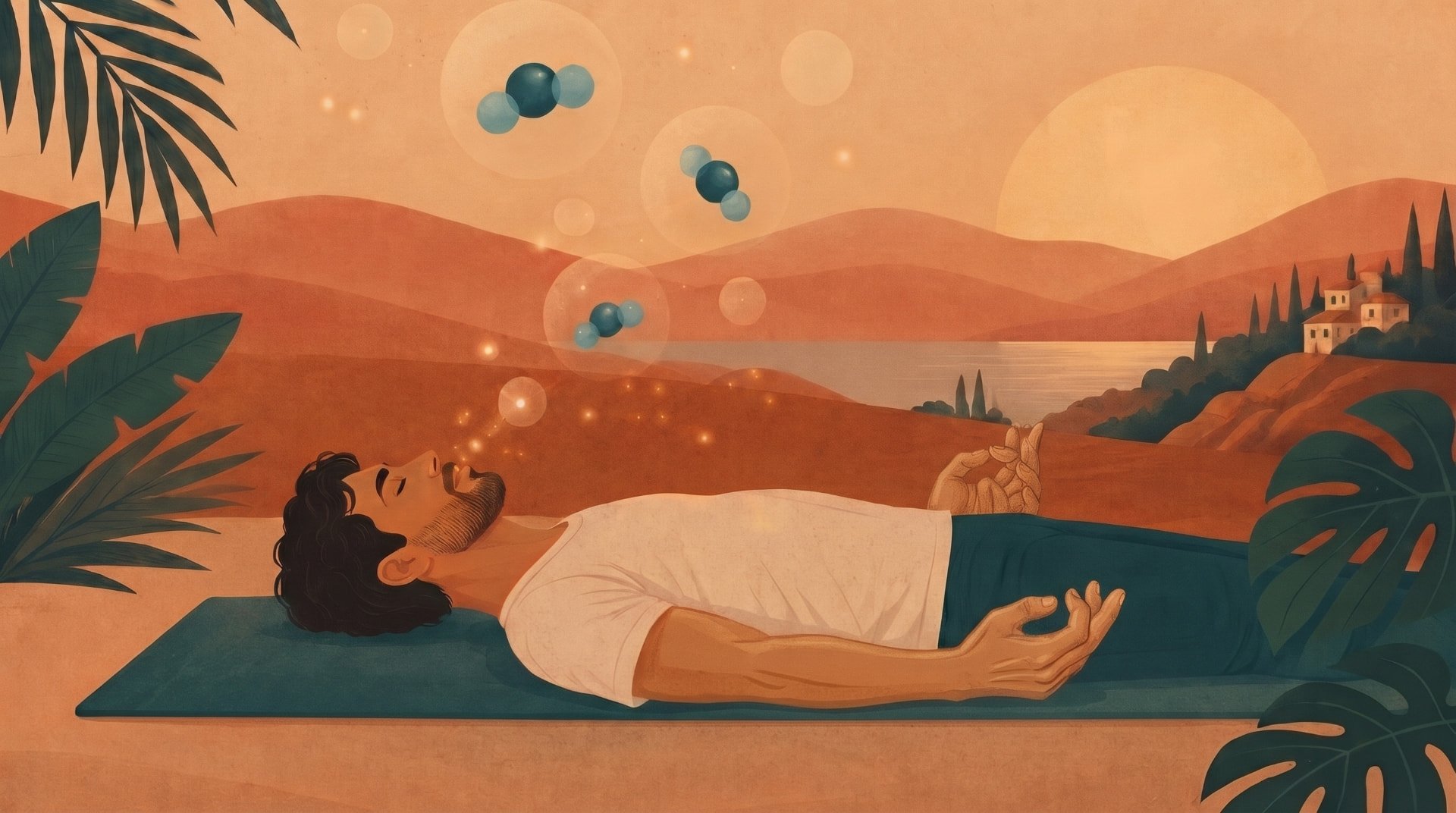 AI-generated image
What tetany feels like
Tetany usually builds in stages. It often starts as tingling (paresthesia) around the mouth, in the fingertips or in the feet. If fast breathing continues, the muscles of the hands and forearms can tighten: the wrists bend, the fingers stiffen and the thumbs fold towards the palm. Doctors call this posture carpopedal spasm; in German it is known as Pfötchenstellung, and many breathwork circles simply call it "lobster claws". Sometimes the feet, the face or the area around the mouth tighten as well.
The sensation is usually more frightening than dangerous. Many first-timers worry that they are having a stroke or a heart attack. That fear is understandable, but it tends to speed up the breath even more, which can make the cramping stronger. Knowing in advance what tetany is, and that it usually passes once the breath calms, is often the most helpful preparation.
What happens in the body
Tetany during breathwork is a chain reaction that starts with carbon dioxide (CO₂). Understanding the four steps takes much of the fear out of it.
- Step 1 — CO₂ drops (hypocapnia): Fast or deep connected breathing removes CO₂ faster than your cells produce it. A 2025 study that measured exhaled CO₂ during circular breathwork found that it fell markedly during practice.
- Step 2 — the blood becomes more alkaline (respiratory alkalosis): CO₂ forms carbonic acid in the blood. With less CO₂, blood pH rises above its normal range of about 7.35 to 7.45.
- Step 3 — less free calcium: In more alkaline blood, proteins such as albumin bind more calcium. Your total calcium stays the same, but the free, ionized calcium your nerves rely on drops slightly. A laboratory study measured a fall of about 0.036 mmol/L for every 0.1 rise in pH — only a few percent of the normal level, but enough to make a difference.
- Step 4 — nerves start firing on their own: Free calcium and a stable pH help keep nerve membranes steady. As both shift, peripheral nerves become more excitable and begin to fire spontaneously. Sensory fibres produce tingling; motor fibres make muscles contract without your intention.
Classic experiments on voluntary hyperventilation by Macefield and Burke (1991) recorded this directly. Tingling came from spontaneous bursts in sensory nerve fibres and appeared first; tetany followed when motor nerve fibres began to fire as well. The fingers and the area around the mouth are often affected first.
For the bigger picture of these blood-chemistry changes, read our Post on what respiratory alkalosis is.
Is tetany "trapped emotion"? Science and belief
In parts of the breathwork world, cramping hands carry a lot of meaning. Some teachers describe them as holding on, resisting life energy or clinging to control; others link them to a specific memory or to birth. Stanislav Grof, co-founder of Holotropic Breathwork, observed that muscular tensions in his sessions often dissolved when people kept breathing, and he interpreted them as the release of psychological material rather than a purely chemical effect.
Physiology tells a simpler story. Tetany is a predictable response once blood chemistry shifts far enough, and how quickly someone reaches that point differs from person to person. It does not show that you are doing something wrong, nor that you are holding on to something specific.
The mind still plays a role. Fear, effort and bracing tend to make the breath faster and the muscles tighter, so anxiety can intensify and prolong tetany. Many people notice that the cramping eases as they soften the exhale and stop fighting the sensation. A helpful way to hold both views: tetany is chemistry, and the way you relate to it shapes how it unfolds. Feelings or memories that come up alongside it are worth noticing and integrating, without treating the cramp itself as proof of a hidden cause.
How to let tetany ease during a Session
If your hands start to cramp, there is usually no need to end the Session. These steps help the body rebalance.
- Soften the exhale: Let the out-breath fall out by itself instead of pushing it. In Rebirthing Breathwork, a relaxed, passive exhale is part of the technique anyway.
- Slow down and breathe through the nose: Slower breathing through the nose lets CO₂ build back up.
- Lengthen the out-breath: For example, breathe in for about four counts and out for six to eight counts.
- Pause gently after the exhale: A brief, comfortable pause lets CO₂ rise naturally. There is no need to force long breath-holds.
- Don't force the fingers open: Prying cramped hands apart can hurt. Let them rest, wiggle them gently, or shake out your arms once they loosen.
- Stay warm and lying down: A blanket, a relaxed jaw and a hand on the belly help many people settle.
- Skip the paper bag: Rebreathing into a bag is no longer recommended as self-help, because it can lower oxygen levels, especially if fast breathing has a medical cause.
Once breathing calms, CO₂ rises again, blood pH moves back towards normal and calcium is released from its protein binding. In healthy people, tingling and cramping usually fade within a few minutes and leave no lasting effects, although the hands can feel tired or sensitive for a while.
For gentle recovery breathing after a Session, try coherent breathing or box breathing with the free Breathing Pacer.
When tetany is normal — and when to get medical advice
Tetany during breathwork is usually harmless when it appears during fast or deep breathing and eases within minutes once the breath calms. Have it checked by a doctor in these situations.
- Cramping without fast breathing: Muscle spasms, tingling or cramps at rest or in everyday life can point to low blood calcium or magnesium.
- It does not ease: The cramping persists for more than about ten minutes after your breathing has returned to normal.
- Known risk factors: A history of thyroid or parathyroid surgery, kidney disease, an eating disorder, or medication that affects calcium or magnesium. Talk to your doctor before practising high-ventilation breathwork.
- Emergency signs: Chest pain, one-sided weakness or numbness, a drooping face, slurred speech, confusion or fainting need emergency help (112 in Germany) — not more breathing.
Doctors check for latent tetany with simple tests such as the Trousseau sign: in people with low calcium, a blood-pressure cuff inflated on the upper arm can trigger the same hand posture.
Before your first high-ventilation Session, read our guide to breathwork contraindications or take the free Safety Check.
Frequently asked questions
Is tetany during breathwork dangerous?
In healthy people it is usually not dangerous and fades within minutes once breathing calms. It can feel intense, and it needs medical attention if it appears without fast breathing, does not ease, or comes with chest pain, weakness or confusion.
Why do my hands cramp during breathwork?
Fast connected breathing lowers CO₂, which makes the blood more alkaline and reduces free calcium. Nerves in the hands then fire spontaneously, causing tingling and cramping.
Does tetany mean I am blocking emotions?
Not necessarily. Tetany is mainly a chemical response to over-breathing. Fear and bracing can intensify it, but the cramp alone does not reveal a hidden emotional cause.
Will it happen in every Session?
Not necessarily. Many people report that it happens less often as they learn to relax the exhale and find a breathing pace that suits them.
Can I continue the Session when my hands cramp?
Usually yes, by softening and slowing the breath until the cramping eases. If it feels overwhelming, open your eyes, breathe slowly through your nose and let your facilitator know.
The bottom line
Cramping hands during breathwork can look and feel dramatic, but in most cases they are a temporary, well-understood effect of lower CO₂ and less free calcium. Knowing the mechanism, softening the exhale and letting the breath slow down usually brings the hands back within minutes. Experienced guidance makes this much easier: in a Berlin Group Session or a private Individual Session, you are supported in finding a breathing pace that keeps the experience manageable.
SourcesLast reviewed: October 2026
- · Macefield G, Burke D. Paraesthesiae and tetany induced by voluntary hyperventilation (opens in a new tab). Brain, 1991.
- · Laffey JG, Kavanagh BP. Hypocapnia (opens in a new tab). New England Journal of Medicine, 2002.
- · Brinkman JE, Sharma S. Respiratory Alkalosis (archived) (opens in a new tab). StatPearls, NCBI Bookshelf, updated regularly.
- · Wang S, McDonnell EH, Sedor FA, Toffaletti JG. pH effects on measurements of ionized calcium and ionized magnesium in blood (opens in a new tab). Archives of Pathology & Laboratory Medicine, 2002.
- · Goyal A, Anastasopoulou C, Ngu M, Singh S. Hypocalcemia (opens in a new tab). StatPearls, NCBI Bookshelf, updated regularly.
- · Patel M, McMahon K, Hu EW. Trousseau Sign (opens in a new tab). StatPearls, NCBI Bookshelf, updated regularly.
- · Callaham M. Hypoxic hazards of traditional paper bag rebreathing in hyperventilating patients (opens in a new tab). Annals of Emergency Medicine, 1989.
- · Gardner WN. The pathophysiology of hyperventilation disorders (opens in a new tab). Chest, 1996.
- · Havenith MN et al. Decreased CO₂ saturation during circular breathwork supports emergence of altered states of consciousness (opens in a new tab). Communications Psychology, 2025.
- · Grof S, Grof C. Holotropic Breathwork: A New Approach to Self-Exploration and Therapy (opens in a new tab). SUNY Press, 2010. (Founder's book)
Evidence note. The chain from lower CO₂ to higher blood pH, less ionized calcium and more excitable nerves is well established in physiology textbooks and experimental studies. Few studies have measured tetany during breathwork Sessions directly, and interpretations of its emotional meaning come from practice traditions rather than research. If cramping appears outside fast breathing, speak to a doctor.
Curious to experience Breathwork for yourself?
Explore the next Breathwork Group Sessions in Berlin and find a date that works for you.
Take the private 2-minute check to see whether breathwork may be suitable for you right now.
Talk with me for 15 minutes, without obligation, and explore which kind of support may fit you.