11 JULY 2026·3 MIN READ·Last reviewed: OCTOBER 2026
The Wim Hof Breathing Method - How does it actually work?
If you have spent any time exploring the world of wellness, you have likely heard of Wim Hof—the Dutch extreme athlete nicknamed "The Iceman." While Rebirthing Breathwork is primarily a somatic journey into the emotional subconscious, the Wim Hof Method (WHM) breathing focuses mainly on the body: practitioners use it to build a sense of physical resilience, energy and calm under stress.
It is an accessible technique that deliberately triggers a short-term stress response in the body. Many practitioners describe it as practice in staying calm under pressure.
How it Works: The 3 Phases of a Round:
A standard Wim Hof breathing session consists of 3 to 4 consecutive rounds. Each round follows the same three-phase cycle.
1. The Power Breaths: 30 to 40 breaths.
Sit or lie down in a safe, comfortable place. Take 30 to 40 deep, rhythmic breaths. Inhale fully through your mouth or nose, expanding your belly and chest, and then simply "let go" on the exhalation without forcing the air out. You will likely begin to feel lightheaded or notice a pleasant tingling in your fingers and toes.
2. The Retention (The Hold): 1 to 3+ minutes.
After your last exhalation, empty your lungs comfortably (don't force all the air out, just let it drop) and hold your breath. Close your eyes, relax your shoulders, and witness the stillness. Because the previous phase cleared out your carbon dioxide, your urge to breathe will be significantly delayed. Hold until you feel a clear urge to breathe — never force the hold.
3. The Recovery Breath: 15 seconds.
When your body signals the need to breathe, take one massive, full inhalation to top off your lungs. Hold this breath for 15 seconds, gently squeezing the muscles in your pelvic floor and torso upward toward your head. Release the breath, and you have completed one full round.
The Inner Science: What Happens Inside the Body:
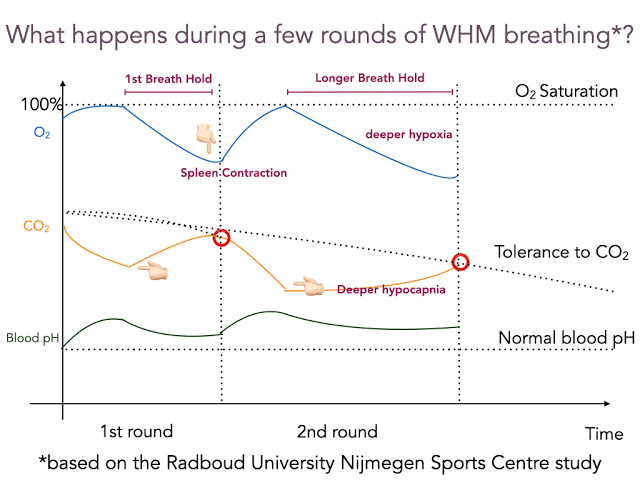
The breathing part of the Wim Hof Method temporarily shifts your blood chemistry. A well-known 2014 study (Kox et al., PNAS) found that trained participants showed a reduced inflammatory response in a lab experiment; research is still limited, so treat this as a promising finding rather than a guarantee. The diagram below gives a simplified picture of how blood chemistry shifts across several rounds of breathing.
When you look at the mechanics of the practice, a few key transformations happen simultaneously:
- Deeper Hypocapnia (Alkalizing the Blood): During Phase 1, the rapid power breaths offload a lot of carbon dioxide, as shown by the dipping orange line. This causes your blood pH (the green line) to rise temporarily, making the blood more alkaline (respiratory alkalosis). This shift alters how oxygen binds to your red blood cells and temporarily reduces the chemical trigger that forces you to breathe.
- Deeper Hypoxia (During the Hold): Because your CO₂ levels are so low, you can hold your breath for a surprisingly long time — but the delayed urge to breathe is not a sign that the hold is safe. During this retention, your oxygen saturation (the blue line) can drop markedly, causing brief oxygen deprivation (hypoxia).
- The Adrenaline Surge: In the Kox et al. (2014) study, trained participants showed a marked rise in adrenaline during the breathing exercises. This short burst of sympathetic activation was linked to a weaker inflammatory response to an injected bacterial toxin in the lab. Whether this translates into better immune health in everyday life is not yet known.
⚠️ An Essential Safety Rule:
Because the power breaths lower CO₂, the urge to breathe can arrive later than your falling oxygen level would warrant, so you may faint without warning. Never, under any circumstances, practice this breathing technique in water, while swimming, in the bathtub, or while driving. Always practice lying down or sitting in a secure, dry environment where briefly losing consciousness would not cause injury. If you are pregnant or have epilepsy, a heart condition or high blood pressure, speak to a doctor first and read about breathwork contraindications.
SourcesLast reviewed: October 2026
- · Kox M et al. Voluntary activation of the sympathetic nervous system and attenuation of the innate immune response in humans (opens in a new tab). PNAS, 2014.
- · Kox M et al. The influence of concentration/meditation on autonomic nervous system activity and the innate immune response: a case study (opens in a new tab). Psychosomatic Medicine, 2012.
- · Muzik O, Reilly KT, Diwadkar VA. “Brain over body” — a study on the willful regulation of autonomic function during cold exposure (opens in a new tab). NeuroImage, 2018.
- · Fincham GW et al. High ventilation breathwork practices: an overview of their effects, mechanisms, and considerations for clinical applications (opens in a new tab). Neuroscience & Biobehavioral Reviews, 2023.
- · Laffey JG, Kavanagh BP. Hypocapnia (opens in a new tab). New England Journal of Medicine, 2002.
- · Macefield G, Burke D. Paraesthesiae and tetany induced by voluntary hyperventilation (opens in a new tab). Brain, 1991.
Evidence note. Research on the Wim Hof Method is still small. The best-known study (Kox et al., 2014) involved 24 healthy young men in a controlled lab setting; it showed a reduced inflammatory response to an injected bacterial toxin, not protection against illness. Several other studies examine Wim Hof himself. Claims about immunity, energy or resilience in everyday life are not yet well supported. Fainting during breath holds is a real risk, which is why the safety rule above matters.
Curious to experience Breathwork for yourself?
Explore the next Breathwork Group Sessions in Berlin and find a date that works for you.
Take the private 2-minute check to see whether breathwork may be suitable for you right now.
Talk with me for 15 minutes, without obligation, and explore which kind of support may fit you.