11 NOVEMBER 2026·14 MIN READ·Last reviewed: NOVEMBER 2026
4:8 Breathing: How to Calm Your Nervous System with Longer Exhalations
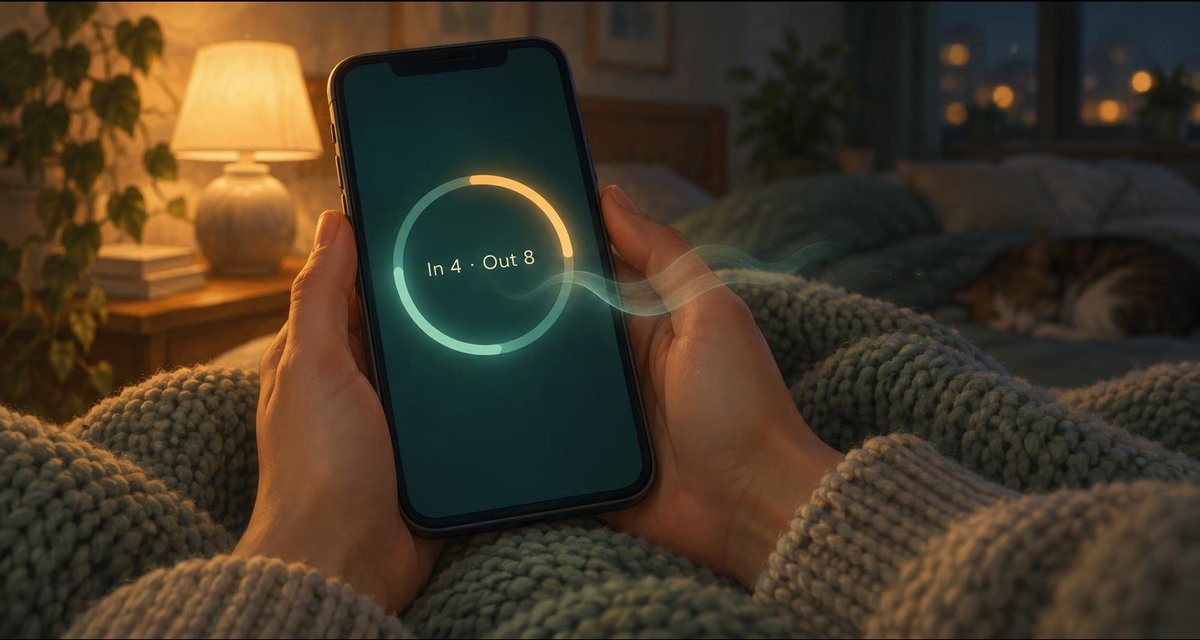
Breathe in for 4 seconds, breathe out for 8 seconds — that is the whole technique. With no breath holds and a 12-second cycle, 4:8 breathing settles you at five calm breaths per minute and makes every exhale twice as long as the inhale. It is one of the simplest ways to tell your nervous system that it is safe to slow down, and a gentle alternative to the popular 4-7-8 breath for anyone who finds breath holds uncomfortable. This Post explains what happens in your body when you lengthen the exhale, what three key studies show, how 4:8 compares to related techniques — and how to practice it right now with the free Breathing Pacer.
 AI-generated image
What Is 4:8 Breathing?
4:8 breathing is a slow, extended-exhale pattern: you breathe in gently through the nose for a count of four and let the breath flow out for a count of eight, without pausing at the top or the bottom. One full breath takes 12 seconds, which means five breaths per minute and an inhale-to-exhale ratio of 1:2. In the yoga tradition, breathing with unequal inhale and exhale lengths is sometimes called Visama Vritti; in breathing apps and sleep guides you will often find it as the 4:8 or 1:2 breath.
The exhale should feel like a long, relaxed release rather than a push. Slightly pursed lips or a soft, quiet nasal exhale both help to slow the out-breath. In the Breathing Pacer this rhythm is called the 4:8 wind-down, with a warm 396 Hz tone on the inhale and a deep 285 Hz tone on the exhale.
4:8 vs. 4-7-8: Same Ratio, No Breath Hold
The well-known 4-7-8 breath asks you to breathe in for 4, hold for 7 and breathe out for 8. Both techniques share the long 8-second exhale and roughly the same 1:2 inhale-to-exhale ratio. The difference is the 7-second hold. For many beginners, people with low CO₂ tolerance or anyone who tends towards anxiety, that hold can trigger air hunger, a racing heart or the urge to gasp — the opposite of what a calming exercise should do.
4:8 keeps what makes 4-7-8 calming — slow pace and a long exhale — and simply leaves out the retention. The breath keeps flowing, which many people find easier to sustain for several minutes. If you enjoy breath holds and want the deeper sedative feel of 4-7-8, it remains a good option; if the hold makes you tense, 4:8 is the gentler door into the same territory. More on CO₂ tolerance and why some people struggle with holds: CO₂ Tolerance and the BOLT Test.
Try 4:8 Breathing Now
Rather than counting seconds in your head, let the Pacer set the rhythm: breathe in while the circle grows, breathe out while it slowly shrinks. The Pacer below is already set to the 4:8 wind-down pattern: start with two minutes and simply follow.
Free breathwork timer
In 4 · Out 8
Ready when you are
Solfeggio tones: 396 · 285 Hz
Why a Longer Exhale Calms You: The Physiology
The exhale is your heart's brake
Every breath gently changes your heart rate. When you breathe in, the vagus nerve — the main nerve of the parasympathetic, calming branch of the nervous system — loosens its brake on the heart, and heart rate rises a little. When you breathe out, the brake engages again and the heart slows down. This healthy rhythm is called respiratory sinus arrhythmia. By making the exhale twice as long as the inhale, 4:8 breathing spends two thirds of every breath in the phase in which the vagal brake is active.
A two-way line between body and brain
The vagus nerve does not only carry commands down to the heart. Roughly 80 percent of its fibres run the other way, from the heart, lungs and gut up to the brainstem. These upward signals constantly report how the body is doing. A slow, unhurried exhale and a calmer heartbeat are exactly the kind of information the brain reads as "no danger right now". That is one reason why slowing the breath can quiet the mind too: you are not only relaxing muscles, you are sending the brain a steady message of safety from below.
Slow breathing near the resonance zone
The second ingredient is pace. At five breaths per minute, one breath takes 12 seconds, which places 4:8 close to the slow rhythm of about ten seconds (around 0.1 Hz) at which the baroreflex — the feedback loop that keeps blood pressure stable — naturally oscillates. Breathing near this tempo lets heart rate and blood pressure rise and fall in large, smooth waves and typically increases heart rate variability during practice. The exact physiology of this resonance is explained in detail in Coherent Breathing & Heart Rate Variability.
Fewer breaths, less arousal
Finally, 4:8 is a low-ventilation pattern. Five slow, quiet breaths per minute move less air than the twelve to fifteen breaths of everyday breathing, so CO₂ stays stable or rises slightly instead of dropping. That is the opposite of activating high-ventilation styles, and one reason why the long exhale feels grounding rather than stimulating.
What the Research Says
Longer exhale, more relaxation
In a 2014 study from KU Leuven, Ilse Van Diest and colleagues asked thirty participants to breathe at either 6 or 12 breaths per minute, each with either a short inhale and long exhale or the reverse. Breathing with the longer exhale led to more self-reported relaxation, stress reduction, mindfulness and positive energy than breathing with the longer inhale. Only during slow breathing did the longer exhale also increase the high-frequency component of heart rate variability, a marker of vagal activity. The authors concluded that the inhale-to-exhale ratio is an important modulator of both the bodily and the felt effects of slow breathing.
Prolonged exhale and parasympathetic activity
A small 2018 study by Tomoko Komori at Mie University compared prolonged expiratory breathing — 4 seconds in and 6 seconds out — with rapid breathing of one second in and one second out in ten healthy young men. During the prolonged exhale, measures of parasympathetic activity in heart rate variability increased significantly; during rapid breathing they were suppressed. The author points out that HRV is an indirect method with clear limitations, but the direction of the effect fits the wider research on slow, exhale-focused breathing.
Timing shapes the heart's rhythm
An earlier study from the University of Vienna by Gerhard Strauss-Blasche and colleagues (2000) compared two breathing styles at the same rate of about ten breaths per minute: a short inhale followed by a long exhale, and a long inhale followed by a short exhale. The short-in, long-out pattern produced clearly larger respiratory sinus arrhythmia — bigger heart-rate waves with each breath — and this could not be explained by differences in breathing rate or depth. The relative timing of inhale and exhale is therefore a third lever on the heart's rhythm, alongside pace and depth.
The closest match so far: 4-4-8
The pattern closest to 4:8 tested in a laboratory is 4-4-8: four seconds in, a four-second pause, eight seconds out. In a 2024 crossover study, Ryota Kobayashi and Hideyuki Negoro had fifteen healthy young men breathe this way for about five minutes. Thirty minutes later, blood pressure and a measure of arterial stiffness had dropped, and the calming, vagal part of heart rate variability had risen — none of which happened in the control condition. It is a small, single-session study, and the four-second hold makes it not quite 4:8, but it is the nearest tested relative.
A longer exhale at your own pace
In a 2021 study, Dalbyeol Bae and colleagues asked 28 younger and older adults to breathe at their own natural rate, once with equal inhale and exhale and once with an exhale twice as long. The longer exhale raised vagally mediated heart rate variability — and the effect was still measurable about four minutes after the exercise ended. Notably, this worked without slowing the breath at all, which suggests the exhale ratio itself can matter, not just the pace.
When the ratio does not seem to matter
Other research points the other way. In the largest trial so far, Gurjeet Birdee and colleagues randomly assigned 100 healthy adults to twelve weeks of slow breathing with either a longer exhale or equal inhale and exhale. Both groups became significantly less stressed — and the longer exhale added nothing measurable on top. And when Zachary Meehan and Fred Shaffer tested a 1:2 ratio against 1:1 at a slow six breaths per minute in two separate studies, heart rate variability came out the same. Their review of nine earlier studies found four different conclusions. The honest summary: slowing down is the reliable part; whether the exhale is longer matters less than finding a rhythm you can comfortably keep.
What this does and does not show
Taken together, the research supports a careful picture: slow breathing calms, and a longer exhale often deepens the felt relaxation — but it does not reliably add heart-rate benefits beyond simply slowing down. None of the studies tested exactly 4 seconds in and 8 seconds out, most were small and short, and the largest trial found no extra effect of the ratio at all. 4:8 is best seen as a well-founded, gentle relaxation tool — not a treatment, and not the one perfect ratio for everyone.
4:8 and Related Techniques Compared
4:8 sits in a small family of slow, exhale-focused patterns. Each has a slightly different character — choose by what you need right now:
| Technique | Rhythm (seconds) | Inhale : exhale | Breath hold | Good for |
|---|---|---|---|---|
| Coherent breathing | In 5.5 · Out 5.5 | 1 : 1 | No | Daily balance, HRV practice |
| Gentle longer exhale | In 4 · Out 6 | 1 : 1.5 | No | A soft first step, calming in a tense moment |
| 4:8 wind-down | In 4 · Out 8 | 1 : 2 | No | Evening, before sleep, deep calm without holds |
| Physiological sigh | Double inhale · long exhale | about 1 : 2 | No | A quick reset in acute stress, a few rounds |
| 4-7-8 breathing | In 4 · Hold 7 · Out 8 | 1 : 2 (plus hold) | Yes, 7 s | Deep sedation for those comfortable with holds |
If 4:8 feels too long at first, begin with the gentle 4:6 longer exhale and lengthen the out-breath over a few days. If you like structure and want to feel balanced rather than sleepy, coherent breathing is the natural daytime partner. All five patterns are included in the free Pacer above. You will find step-by-step descriptions of each in 11 Simple Breathing Techniques to Practice at Home.
How to Practice 4:8 Breathing
- Get comfortable. Sit upright with your back supported or lie down on your back. Let your jaw, shoulders and belly soften.
- Breathe in for 4. Inhale quietly through your nose, letting the breath move into the lower ribs and belly.
- Breathe out for 8. Let the air flow out slowly through the nose or slightly pursed lips. Do not force the last bit of air out — the exhale should feel like letting go.
- No pauses. Turn smoothly from inhale to exhale and back again, so the breath keeps flowing.
- Keep it small. Slow does not mean big. Breathe only as much air as is comfortable; a slight wish for more air is fine, real air hunger is a sign to shorten the counts.
- Start short. Begin with 2–5 minutes and build up to 10 minutes if it feels good. Short, regular practice helps more than an occasional long one.
- Adjust the counts. If 4:8 is too long, try 3:6 (same ratio, faster pace) or 4:6. What matters is the long, relaxed exhale, not exact seconds.
What to notice in your body
After a minute or two, shift some attention from counting to sensing. You might notice:
- Your pulse. Towards the end of each long exhale, around seconds six to eight, the heartbeat often feels a little slower and softer. You can rest two fingers on your wrist or neck to feel it.
- Your chest. With every out-breath the ribs sink a little lower, and the chest can feel heavier, wider and more settled.
- Your throat. A slow exhale often releases tightness in the throat. Some people notice an easier swallow or a softer voice afterwards.
- Your jaw and face. Teeth come apart, the tongue rests and the area around the eyes softens. If you catch yourself clenching, let the next exhale melt it.
There is no right sensation to chase. Simply noticing what changes is part of the practice: it trains your attention to register calm in the body, not just in the mind.
One Round Calms, Daily Practice Trains
A single round of 4:8 breathing changes your state: heart rate slows and the body shifts down for a while. That effect is real, but it fades. What makes a difference over time is repetition. When you practice a few minutes every day, your nervous system keeps getting the same experience of shifting from tension into calm. Many people find that over weeks this shift becomes quicker and easier to reach, even outside practice. In one 2023 study, five minutes a day of structured slow breathing for four weeks improved mood and lowered the resting breathing rate more than mindfulness meditation did — a hint that short daily practice really adds up. Research on lasting effects is still limited, so see this as training a skill rather than a guaranteed change.
You aren't simply trying to feel relaxed for five minutes. The goal is to repeatedly give your nervous system the experience of slowing down and returning toward safety. The formula is simple: 4 seconds in, 8 seconds out, 5 minutes a day.
When to Use 4:8 Breathing
- Before sleep. A few minutes in bed can help you shift down after a busy day — more ideas in Breathwork for Sleep and The Military Sleep Method.
- After a stressful moment. Use it to come down after a difficult conversation or a rush through the city — more in Breathwork for Stress Relief.
- As a transition. Between work and evening, or before meditation, a few rounds mark the shift from doing to resting.
- After an intense Session. A long, relaxed exhale helps you land softly after deep connected breathing in a Breathwork Session.
Safety and Who Should Take Care
4:8 breathing is gentle and suitable for most people. Stop and return to normal breathing if you feel dizzy, tingly, short of air or anxious. Practice sitting or lying down, never while driving, swimming or in water. If you have a heart or lung condition, low blood pressure, are pregnant, or take medication that affects heart rate or blood pressure, talk to your doctor before practicing regularly. People with panic disorder or trauma sometimes find focusing on the breath unsettling at first; in that case keep your eyes open, shorten the counts and go slowly. More on who should take extra care: breathwork contraindications. Planning a more intense breathwork Session? Take the free Safety Check first.
Potential & Limitations
4:8 breathing is free, needs no equipment and can be used almost anywhere. The underlying principles — slow breathing and a longer exhale — are among the better-supported findings in breathing research, and many people notice a calmer body and a quieter mind within a few minutes. It also avoids the breath hold that makes 4-7-8 difficult for some.
Its limits are just as clear: the research is small and short-term, effects are measured during or right after practice, and individual comfort varies. 4:8 is not a treatment for insomnia, anxiety disorders, high blood pressure or any other condition. It can complement professional care, but never replace it.
Frequently Asked Questions
What is 4:8 breathing?
4:8 breathing means breathing in for four seconds and out for eight seconds, without holding the breath. It produces five breaths per minute with an exhale twice as long as the inhale, a rhythm many people experience as deeply calming.
Is 4:8 breathing better than 4-7-8?
Neither is better for everyone. Both share a long exhale and a similar 1:2 ratio. 4:8 leaves out the 7-second hold, which makes it easier for beginners and people who feel anxious or short of air during breath holds.
Why does a long exhale calm the nervous system?
During the exhale the vagus nerve slows the heart. A longer exhale spends more of each breath in this calming phase, and slow breathing at around five to six breaths per minute increases heart rate variability during practice.
How long should I practice 4:8 breathing?
Start with 2–5 minutes. Up to 10 minutes is plenty for most people. Short, regular practice, for example every evening, is more useful than an occasional long Session.
Can 4:8 breathing help me fall asleep?
Many people find it helpful as part of a wind-down routine, because it slows the breath and shifts attention away from racing thoughts. Studies have measured relaxation and heart rate effects rather than sleep itself, so see it as a support, not a sleep treatment.
Should I breathe through my nose or mouth?
Breathe in through the nose if you can. The exhale can go through the nose or through slightly pursed lips — pursed lips make it easier to slow the out-breath at first.
Keep reading
- Coherent Breathing & Heart Rate Variability
- 11 Simple Breathing Techniques to Practice at Home
- Breathwork for Sleep
A long, gentle exhale is one of the simplest daily anchors you can have. If you would like to experience what happens when the breath opens up more fully, join a guided Breathwork Session in Berlin — and use 4:8 breathing to land softly afterwards.
SourcesLast reviewed: November 2026
- · Van Diest I, Verstappen K, Aubert AE, Widjaja D, Vansteenwegen D, Vlemincx E. Inhalation/exhalation ratio modulates the effect of slow breathing on heart rate variability and relaxation (opens in a new tab). Applied Psychophysiology and Biofeedback, 2014.
- · Komori T. The relaxation effect of prolonged expiratory breathing (opens in a new tab). Mental Illness, 2018.
- · Strauss-Blasche G, Moser M, Voica M, McLeod DR, Klammer N, Marktl W. Relative timing of inspiration and expiration affects respiratory sinus arrhythmia (opens in a new tab). Clinical and Experimental Pharmacology and Physiology, 2000.
- · Kobayashi R, Negoro H. Acute effects of the 4-4-8 breathing technique on arterial stiffness in healthy young men (opens in a new tab). Cardiology Journal, 2024.
- · Bae D, Matthews JJL, Chen JJ, Mah L. Increased exhalation to inhalation ratio during breathing enhances high-frequency heart rate variability in healthy adults (opens in a new tab). Psychophysiology, 2021.
- · Birdee GS, Nelson K, Wallston KA, Nian H, Diedrich A, Paranjape SY, Abraham RL, Gamboa A. Slow breathing for reducing stress: The effect of extending exhale (opens in a new tab). Complementary Therapies in Medicine, 2023.
- · Meehan ZM, Shaffer F. Do Longer Exhalations Increase HRV During Slow-Paced Breathing? (opens in a new tab). Applied Psychophysiology and Biofeedback, 2024.
- · Balban MY et al. Brief structured respiration practices enhance mood and reduce physiological arousal (opens in a new tab). Cell Reports Medicine, 2023.
Evidence note. Slow breathing and a longer exhale have been linked to greater self-reported relaxation and higher vagally mediated heart rate variability during practice in small laboratory studies with healthy adults. Studies disagree on whether a longer exhale adds heart-rate benefits beyond simply slowing down — the largest trial found no extra effect of the ratio. No study has tested exactly 4 seconds in and 8 seconds out, lasting effects are not established, and individual responses vary.
Curious to experience Breathwork for yourself?
Explore the next Breathwork Group Sessions in Berlin and find a date that works for you.
Take the private 2-minute check to see whether breathwork may be suitable for you right now.
Talk with me for 15 minutes, without obligation, and explore which kind of support may fit you.