12 OCTOBER 2026·4 MIN READ
A Guide to Modern Shamanism: The Ancient roots of Contemporary Practices such as Breathwork
Shamanism is one of humanity's oldest healing frameworks. Modern shamanism — also called neo-shamanism or contemporary shamanism — is what happens when those practices are taken out of their original cultural context and adapted for people living in cities, in therapy, and in a scientific worldview.
It is not a religion, and it is not a lineage you are born into. It is a set of methods for entering non-ordinary states of consciousness deliberately, meeting what surfaces there, and bringing something useful back into daily life. Breathwork sits squarely inside that toolkit.
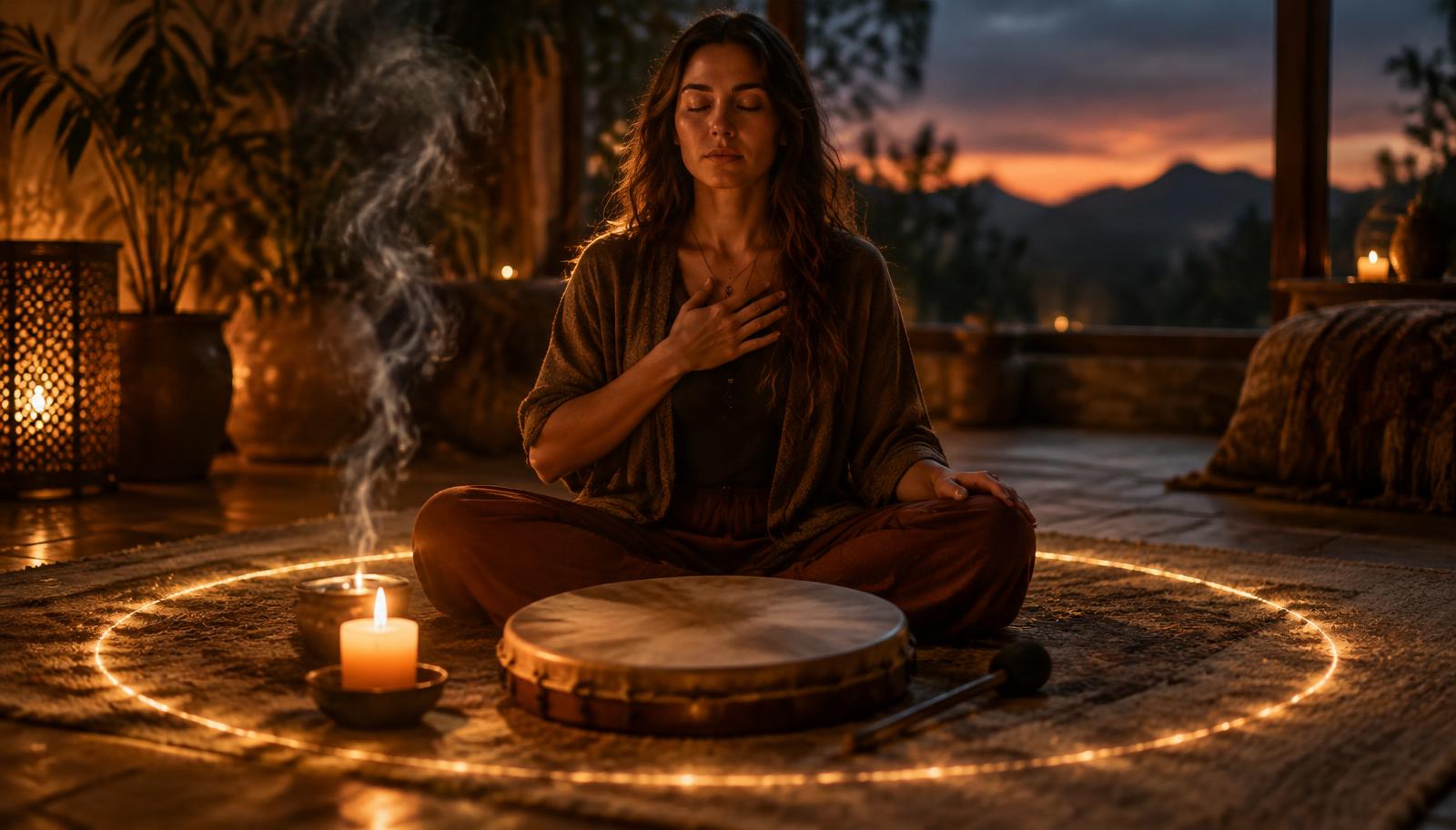 AI-generated image
Where Modern Shamanism Comes From
Traditional shamanic practice is culturally specific: a shaman is a role within a community, trained over years, embedded in a cosmology. Modern shamanism emerged in the second half of the twentieth century when anthropologists and psychologists noticed that very different cultures used strikingly similar techniques to reach altered states — drumming, chanting, dancing, fasting, hyperventilation, plant medicines.
Michael Harner's "core shamanism" was an attempt to isolate those shared mechanics. Stanislav Grof arrived at something similar from the other direction, using high-ventilation breathing to reproduce the states he had previously studied with psychedelics. Both concluded that the state matters more than the ritual dressing around it.
The Core Principles
- Non-ordinary states of consciousness. The work happens in a state that is deliberately different from everyday waking awareness — trance, journey, or expanded state.
- The body as the site of the work. What is unresolved is held somatically, not only cognitively. Movement, breath, and sensation are the entry points.
- Rhythm as the vehicle. Steady drumming, repetitive music, or a sustained breath rhythm entrains the nervous system and carries you across the threshold.
- Inner guidance over external instruction. The facilitator holds the space; your own process supplies the material and the timing.
- Integration as the real work. The experience is not the outcome. What you do with it in the following weeks is.
- Respect for source cultures. Honest modern practice names what it borrowed and does not claim indigenous authority it has not earned.
Shamanic Practice and Breathwork: The Same Doorway
Conscious connected breathing can shift the body and brain in ways that resemble what drumming and dancing do rhythmically. Sustained high-ventilation breathing lowers CO₂, changes cerebral blood flow and is associated with quieter Default Mode Network activity; many people describe imagery, emotional release, and a loosened sense of self — the same territory a shamanic journey describes in different language.
That is why Rebirthing Breathwork, Holotropic Breathwork, and neo-shamanic journeying often feel like relatives. The method is drug-free and adjustable: if you slow the breath, the state usually recedes within a minute or two. If you want the physiology in detail, see the science behind high-ventilation breathwork.
| Element | Traditional shamanic journey | Modern breathwork session |
|---|---|---|
| Entry method | Drum, rattle, chant, plant medicine | Sustained connected breathing |
| Duration | 30–60 minutes | 30–60 minutes |
| Role of guide | Shaman travels or accompanies | Facilitator holds space, tracks the body |
| Content | Visions, spirit encounters, symbolic imagery | Imagery, memory, emotional and somatic release |
| Frame of meaning | Cosmological | Psychological and somatic |
| Afterwards | Community ritual, storytelling | Integration, journaling, coaching |
Trance Dance: Shamanism You Can Practise Standing Up
Trance Dance is one of the clearest living bridges between shamanic technique and contemporary somatic work: blindfold, bandana, driving rhythm, and a specific breathing pattern that can carry you past self-consciousness into movement that is no longer choreographed by the thinking mind.
It uses the same three ingredients — rhythm, breath, and the removal of visual input — that shamanic cultures used for similar purposes. We cover the practice and how it differs from its gentler cousin in Trance Dance vs. Ecstatic Dance.
How to Integrate Shamanic Principles into a Breathwork Practice
- Set an intention, not a goal. Ask a question rather than demanding an outcome. "What needs my attention?" works better than "fix my anxiety."
- Create a threshold. A candle, a specific spot, a few minutes of silence. Marking the beginning tells the nervous system that ordinary rules are suspended.
- Let rhythm carry you. Use music with a steady pulse, or let the breath itself become the drum — the same tempo, sustained, without pauses.
- Do not interpret mid-session. Meaning-making pulls you back into the thinking mind. Feel first, understand later.
- Close deliberately. Ten minutes of stillness at the end is a good habit; many people find this is when the experience begins to settle.
- Integrate within 72 hours. Write it down, move your body, talk it through. Experiences that are not integrated may fade or resurface unexpectedly.
What Modern Shamanism Is Not
It is not a substitute for psychiatric or medical care. It is not a shortcut around grief, trauma, or the slow work of change. And it is not an excuse to wear a costume from a culture you have no relationship with. Practised honestly, it is a plain description of something quite ordinary: humans have always used rhythm and breath to reach the parts of themselves that words cannot get to.
Safety
Non-ordinary states can surface intense material, and high-ventilation breathing has real physiological effects. If you have cardiovascular, neurological, or psychiatric conditions, epilepsy, or are pregnant, read the full guide to breathwork contraindications and work with a facilitator rather than alone.
FAQ
What is modern shamanism?
A contemporary adaptation of traditional shamanic techniques — rhythm, breath, trance, and integration — used for self-exploration and wellbeing rather than within a specific religious cosmology.
Is breathwork a shamanic practice?
High-ventilation breathwork can produce states that resemble shamanic journeying, and several cultures used hyperventilation deliberately. Modern breathwork can be described as a shamanic technique in a secular frame.
Do I need a teacher or plant medicines?
No plant medicines are required — breath, rhythm, and movement are enough. A facilitator is strongly recommended for deep work, mainly for safety and for holding the space.
How is this different from meditation?
Meditation trains attention through stillness; shamanic practice and breathwork use active rhythm and breath to change the state itself. See breathwork vs. meditation.
Curious to experience Breathwork for yourself?
Take the private 2-minute check to see whether breathwork may be suitable for you right now.
Explore the next Breathwork Group Sessions in Berlin and find a date that works for you.
Talk with me for 15 minutes, without obligation, and explore which kind of support may fit you.
Breath & Chill Newsletter
Occasional updates on upcoming Events, new Breathwork Blog Articles and gentle reminders to take a deep breath. No spam, unsubscribe anytime.