11 July 2026
The Wim Hof Breathing Method - How does it actually work?
If you have spent any time exploring the world of wellness, you have likely heard of Wim Hof—the Dutch extreme athlete nicknamed "The Iceman." While Rebirthing Breathwork is primarily a somatic journey into the emotional subconscious, the Wim Hof Method (WHM) breathing is entirely geared toward physiological resilience, nervous system optimization, and physical vitality.
It is a hyper-accessible technique designed to intentionally trigger a short-term, beneficial stress response in the body, teaching your mind to stay calm in the eye of the storm.
How it Works: The 3 Phases of a Round:
A standard Wim Hof breathing session consists of 3 to 4 consecutive rounds. Each round is a precise cycle that must be followed in order to experience the full physiological shift.
1. The Power Breaths: 30 to 40 breaths.
Sit or lie down in a safe, comfortable place. Take 30 to 40 deep, rhythmic breaths. Inhale fully through your mouth or nose, expanding your belly and chest, and then simply "let go" on the exhalation without forcing the air out. You will likely begin to feel lightheaded or notice a pleasant tingling in your fingers and toes.
2. The Retention (The Hold): 1 to 3+ minutes.
After your last exhalation, empty your lungs comfortably (don't force all the air out, just let it drop) and hold your breath. Close your eyes, relax your shoulders, and witness the stillness. Because the previous phase cleared out your carbon dioxide, your urge to breathe will be significantly delayed. Hold until you feel a genuine physical signal to inhale.
3. The Recovery Breath: 15 seconds.
When your body signals the need to breathe, take one massive, full inhalation to top off your lungs. Hold this breath for 15 seconds, gently squeezing the muscles in your pelvic floor and torso upward toward your head. Release the breath, and you have completed one full round.
The Inner Science: What Happens Inside the Body:
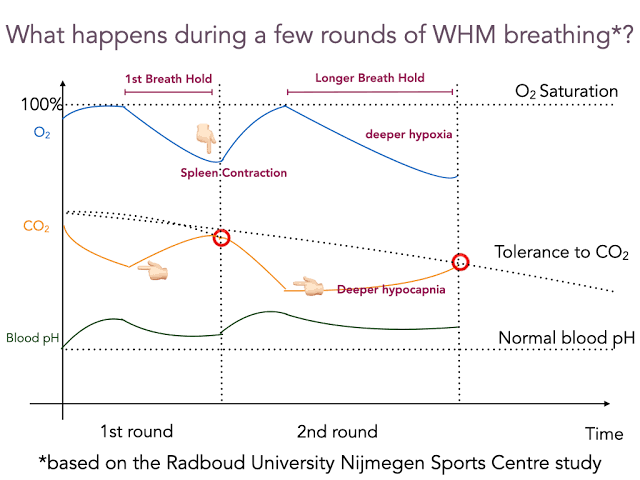
The magic of the Wim Hof Method lies in how it temporarily hacks your biochemistry to boost your immune and nervous systems. The diagram below tracks exactly how your blood chemistry shifts across multiple rounds of breathing.
When you look at the mechanics of the practice, a few key transformations happen simultaneously:
- Deeper Hypocapnia (Alkalizing the Blood): During Phase 1, the rapid power breaths offload vast amounts of Carbon Dioxide, as shown by the dipping orange line. This causes your Blood pH (the green line) to temporarily spike into an alkaline state. This shift alters how oxygen binds to your red blood cells and temporarily reduces the chemical trigger that forces you to breathe.
- Deeper Hypoxia (The Magic of the Hold): Because your CO² levels are so low, you can safely hold your breath for a surprisingly long time. During this retention, your Oxygen Saturation (the blue line) drops rapidly into a state of controlled, brief oxygen deprivation (hypoxia).
- The Adrenaline Surge: This brief plunge into hypoxia acts as a healthy biological alarm clock. Your body releases a massive wave of adrenaline and noradrenaline. This spike activates the sympathetic nervous system in a controlled way, down-regulating systemic inflammation and temporarily supercharging your immune cell activity.
⚠️ An Essential Safety Rule:
Because the Wim Hof Method actively forces CO² down, it suppresses your body's natural drowning reflex. Never, under any circumstances, practice this breathing technique in water, while swimming, in the bathtub, or while driving. Always practice lying down or sitting in a secure, dry environment where it is completely safe if you happen to briefly lose consciousness.